Posts

Showing posts with the label Bible

The Pillar and Ground of Truth
Image
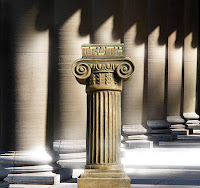
The Bible teaches that the church is the pillar and ground of truth. The apostle Paul wrote to Timothy so that he 'may know how one ought to behave in the household of God, which is the church of the living God, a pillar and buttress of the truth’ (1 Timothy 3:15). The church is pictured like a pillar and ground, upholding and supporting God’s revealed truth. The apostle identifies the church as God's household; he is referring to every true Christian, not only to their leaders. The whole church - all Christians - are collectively the pillar and buttress of truth. Throughout history, God’s people upheld the truth by believing, proclaiming and defending the gospel, by their godly conduct, and sometimes with their blood. That is also our duty today. Paul calls the church, not the Bible, ‘the pillar and ground’ of truth. Being the Word of God, the Bible is not merely ‘the pillar and ground,’ but the ‘truth’ itself. Jesus prayed to the Father, ‘Sanctify them in the truth; your wo...

Is the Bible Enough?

Image
The Bible does not record all that Jesus and his apostles said and did. The apostle John admits that ‘Jesus did many other signs in the presence of the disciples, which are not written in this book’ (John 20:30). Does this imply, as some argue, that the Bible is not sufficient and that we need an additional source of revelation, namely Sacred Tradition? I think it is crucial to make a very important distinction. We must not confuse ‘sufficient, enough, adequate, ample’ with ‘all, exhaustive, comprehensive.' Do we really need to know all that Jesus said and did, and all that the apostles taught and did? Even if God did provide us with that vast amount of data, could we handle the tsunami of information? If I’m thirsty, do I need to drink all the fresh water in the world? No, of course, not! A glass or two will be enough to satisfy my thirst. Or, to give another illustration, when I diagnose a young boy with asthma, I spend time with the child and his parents to teach them about ...

The Rule of Faith

Image
While God revealed the plan of salvation to Israel and the early church, the Holy Spirit moved holy men to write the message he wanted to give to future generations. Today we do not have apostles and prophets living among us, and Christ has ascended back to heaven. Yet we still have their teaching recorded in the God-breathed Scriptures. Therefore, the Holy Bible is the only infallible rule of faith for the Christian church. This principle, known by the Latin phrase Sola Scriptura (‘Scripture Alone’), is a landmark of fundamental importance because it determines the faith and character of the church of God.

God is Speaking

Image
By ourselves, we can never come to a true knowledge of God. Throughout history and in different cultures, people have fashioned a host of gods and diverse religions. Left to our own resources we are helpless and hopelessly lost; we cannot find the true and living God. ‘The world through wisdom did not know God’ (1 Cor 1:21). We can only know God because he was pleased to show himself to us. God manifested himself in a general way by the works of his hand, that is, the created universe. Thus nobody has a valid excuse; nobody may rightly claim that he didn’t know about God (Rom 1:19). Furthermore, it pleased God to reveal himself to us in a special and personal way. God has spoken and he still speaks to us today through his Word, the Holy Bible. We will look at the three steps involved in the communication process: revelation, inspiration and illumination.

The Bible is the Word of God

Image
The Bible is a unique book. Among the millions of books ever written, the Bible alone is inspired by God. It is God-breathed, the very Word proceeding from his mouth (2 Timothy 3:16). The human authors of the Bible (Moses, Isaiah, Matthew, Paul and so on) were led by the Holy Spirit to write down his Word accurately and without a mistake (see 2 Peter 1:21). Other books, helpful as they may be, are written by fallible people. The Bible alone is the perfect, infallible and inerrant because its omniscient Author cannot be mistaken. If we are seeking to know the way of salvation and how to please God in our lives, there is no better place to go other than the Bible. The Apostle Paul writes to his dear fellow-worker, Timothy: ‘From childhood, you have known the Holy Scriptures, which are able to make you wise for salvation through faith which is in Christ Jesus. All Scripture is given by inspiration of God and is profitable for doctrine, for reproof, for correction, for instruction in rig...

What Sola Scriptura Does NOT Mean

Image
(Gospel e-Letter - March 2013) What do evangelicals mean by the term ‘sola Scriptura’ – by Scripture alone? An evangelical may answer, ‘As a Christian I do not need anything else besides the Bible – there is no need for tradition, creeds, councils or even a statement of faith. I can interpret the Bible for myself apart from the church, ministers, teachers or fallible human books.’ Unfortunately many evangelicals would agree with that description of sola scriptura. But that popular concept is NOT what the Reformation principle of ‘sola Scriptura’ stands for. 1. Sola Scriptura asserts that the Bible is the complete Word of God to the church, and thus it is sufficient as a rule of faith and practice for God’s people. The Bible is God’s full message to us and there is nothing missing that we must discover through tradition or further divine revelation. Nonetheless there is a legitimate place for tradition. ‘Tradition’ is not a dirty word; it simply means the handling down of b...

If I were a Catholic Apologist

Image
If I were a Catholic apologist, I would concentrate my attacks on evangelicals on two doctrines, namely sola scriptura and sola fide . Given the gross spiritual ignorance and rampant error among evangelicals, I should be able to destroy the very foundations of their religion in no time. Take the popular concept of sola scriptura among many evangelicals. They think that the Bible teaches that the Bible alone is the only authority, and thus they reject the claims of an infallible magisterium of the Roman Catholic Church, and indeed of every other authority, including the authority of their own local churches and their pastors. There is no need for many arguments. One is enough. I would ask a very simple question: “Since you believe that the Bible is the only authority, show me from the Bible alone which books should be included in the Bible and which should be excluded?” Their answer will be dead silence. You cannot show from the Bible alone which books are inspired and which b...

God Speaks to Us Today

Image
The Bible is a collection of old writings by several authors over a span of many centuries, originally addressed to the Jews or the early Christians. Why should we put our confidence in this old book? Is it still relevant to us today? The Lord Jesus gives us a good insight on the value of the Scriptures. During a debate with the Sadducees (who denied the resurrection), Jesus said, ‘But about the resurrection of the dead -- have you not read what God said to you, “I am the God of Abraham, the God of Isaac, and the God of Jacob?” He is not the God of the dead but of the living’ (Matt 22:31, 32). Let us focus on the very significant phrase, ‘Have you not read what God said to you?’ We learn, first of all, that Jesus regarded God as the author of the Bible. He knew of course that the book of Exodus, from which he quoted, was written by Moses. But Jesus looked beyond the human author. ‘Have you not read,’ he asked, ‘what God said to you?’ God is the ultimate author of the Bible, for as ...

Answers to Catholic Arguments on Authority

The following six questions were asked by a Catholic apologist, John Martignoni. 1) Could the Holy Spirit, through the universal Church (which is the Body of Christ), have enabled believers – particularly the Bishops (the successors of the Apostles), in the first few hundred years of the Church, to faithfully and accurately pass along the traditions Paul taught by “word of mouth”? Yes, or no? Yes. But they could have also mixed the apostolic teaching with much error, just as God's people of old did before to the teaching of the Prophets. "Could" implies possibility not certainty! Could God have created a 3-legged creature on Pluto? Yes. Did he? Perhaps he did, but I'm pretty sure he didn't. 2) Are you infallible in your interpretations of Scripture? Was Martin Luther infallible in his? Or John Calvin? Yes, or no? (Note: this question concerns not your personal infallibility, but the infallibility of your scriptural interpretations. No, no, no, and so will any sens...